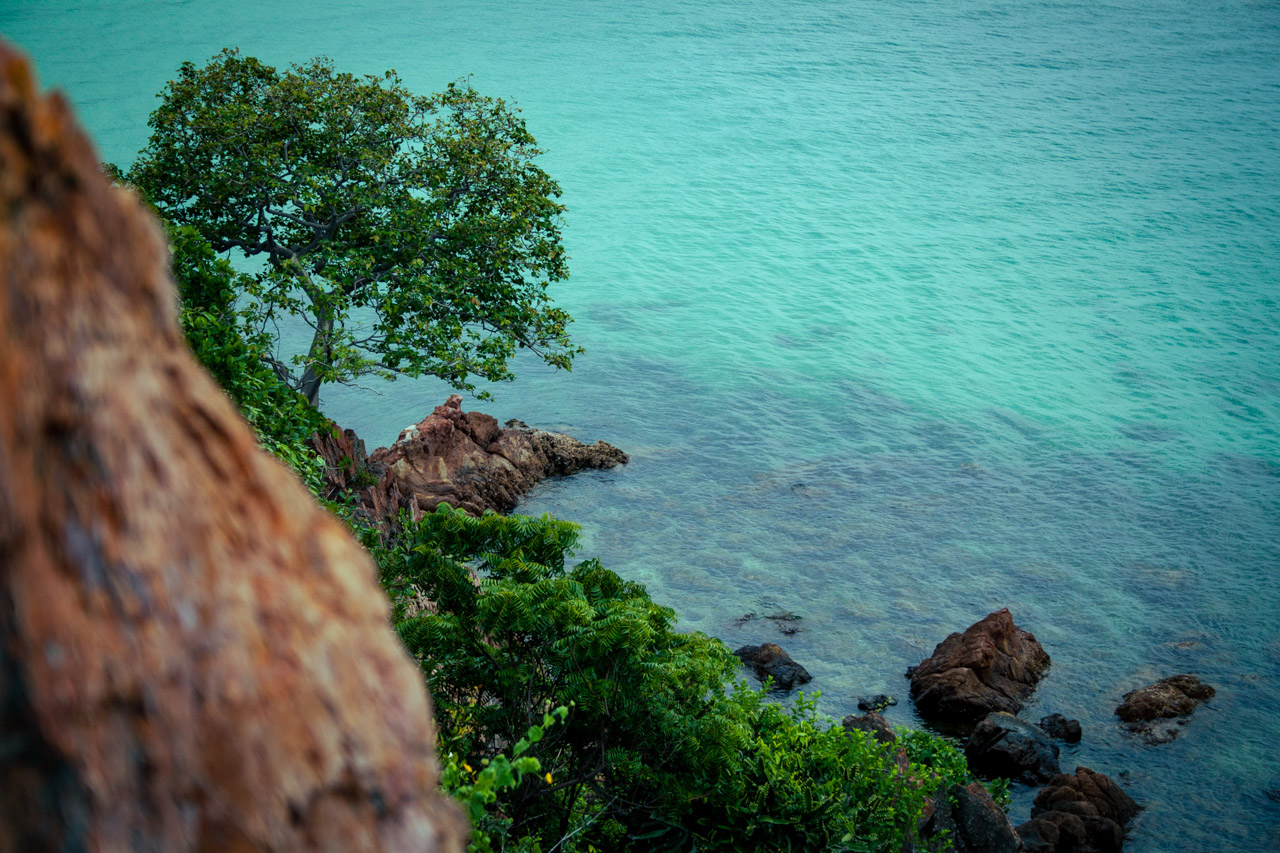
Koh Larn is a small island sitting so close to Pattaya that it’s visible from almost any point along the city’s coastline. It runs just over 4.5 kilometres in length and about 2 kilometres across, and were it not for the heat and hills reaching up to 180 metres, you could easily cover the whole island on foot.
- History
- Koh Larn today
- Best beaches
- Where to stay
- How to get to Koh Larn from Pattaya
- Getting around
- Things to do
- Legends and myths
History of Koh Larn
The island’s name has no firmly established origin. One theory ties it to coral, and it’s sometimes marketed to tourists as “Coral Island” — though, to my mind, that’s simply a pretty story. The island was settled long before tourism ever arrived, and its people historically made their living from entirely different pursuits: farming, growing coconuts, and, of course, fishing.
A second theory traces the name to the bare patches on the island’s hills — laan in the local dialect — and this version strikes me as considerably more plausible.
Before tourism took hold, the island held two villages, each living its own unspurred, everyday life, complete with its own temple and school. Koh Larn, in other words, could once genuinely be called self-sufficient.
But the island was known for something else, even before its first tourists ever arrived. Back in the first half of the 20th century, Koh Larn was mined for a mineral called psilomelane. Official records from the Department of Mineral Resources place the deposits in the island’s south, around Laem Tham Rae. Without getting too deep into the geology, it’s essentially a blend of several manganese-bearing minerals — some Thai sources simply call it manganese outright. It was precisely this mineral that formed the subject of a wartime export agreement between Thailand and Vietnam, and a dedicated pier was even built specifically to ship it out.
Tourism itself arrived on Koh Larn much as it did in Pattaya — with American soldiers from the U-Tapao airbase during the Vietnam War. As soldiers began visiting the island for leisure, locals gradually shifted away from their traditional trades towards tourism instead: ferrying visitors by boat, selling food and drink, offering places to stay. As word of this island paradise spread further, visitor numbers grew, and the island’s economy transformed all the more rapidly as a result.
Koh Larn today
Today, Koh Larn ranks among Pattaya’s leading natural attractions, having come under the city’s administration back in 1978. It’s fair to say the island offers the finest beaches anywhere near Pattaya — which may well explain why some 500,000 people visit every month. This has thoroughly reshaped the island’s economy around tourism, though a small number of residents still make their living from fishing.
That flood of visitors has, inevitably, brought the sort of problems any small island tends to face: enough fresh water, enough electricity, adequate transport, and waste disposal.
Koh Larn simply doesn’t have enough natural freshwater sources to support this volume of visitors, so the authorities have turned to a mix of alternatives: desalinating seawater, harvesting rainwater, tapping groundwater, and even shipping water in from the mainland.
Waste is another serious headache. With so many visitors passing through daily, the island generates around 15 tonnes of household waste every single day. The authorities are doing what they can to manage it, though it’s a genuinely difficult problem for any small island to solve.

Best beaches on Koh Larn
Koh Larn has plenty of small beaches and coves, and it’s fair to say these are the best beaches anywhere near Pattaya, still holding on to their white sand and clear blue water. The most popular are:
- Tawaen Beach — the busiest and most developed, and, inevitably, the most crowded as a result — though it’s also where you’ll find the widest range of activities.
- Tien Beach — popular too, though noticeably quieter, with all the infrastructure you’d need and a genuinely picturesque setting.
- Samae Beach — another well-known beach, fully equipped, with a viewpoint overlooking the coastline.
Since I tend to prefer quieter, less crowded spots, my own favourites on Koh Larn are Nual Beach (also known as Monkey Beach) and Ta Yai Beach. Both sit in small, secluded coves, and on weekday mornings you’ll find hardly anyone around — plenty of peace and nature to enjoy. Nual Beach does have wild monkeys, though, so keep an eye on your belongings, and it’s best not to bring anything valuable at all.
Where to stay on Koh Larn
Koh Larn offers a fairly wide range of accommodation, though most of it falls into what I’d call “island-style” lodging — there isn’t a single chain hotel on the island. Among the better options:
- Madusea Grand Villa — a boutique hotel with stylish rooms and villas, complete with its own pool and restaurant.
- Tiennara Resort — a handful of villas right on Tien Beach.
- Théo Privé Kohlarn — a genuinely modern, island-style beach hotel, though it sits on Tawaen Beach, so privacy and quiet aren’t really on offer here.
Personally, though, I see little reason to stay overnight on Koh Larn at all. It’s better suited to a day trip, particularly given how easily it’s reached from Pattaya.
How to get to Koh Larn from Pattaya
From morning until around 5pm, ferries and speedboats run between Bali Hai Pier in Pattaya and Koh Larn — ferries on a fixed schedule, speedboats whenever they fill up.
By speedboat, the crossing takes 15–20 minutes; by ferry, around 40. I generally prefer the ferry myself — it’s the calmer option. Speedboats are noisy and bounce hard over the waves, which can make for an uncomfortable ride if you’re prone to motion sickness.
Getting around Koh Larn
You can’t bring your own bike or car onto Koh Larn, so you’ll need to rely on local transport instead — songthaews, taxis, or a rented motorbike.
Despite the island’s modest size, walking everywhere in the daytime heat, over hilly terrain, gets tiring fast.
Things to do on Koh Larn
Beyond simply lying on the beach, the most popular activity here is snorkelling or diving, thanks to the coral reefs surrounding the island. I haven’t tried it myself, since the water in this part of the Gulf of Thailand isn’t especially clear, and I didn’t much fancy spending time on an activity I already knew wouldn’t live up to expectations. That said, it’s a perfectly good spot for a first attempt, ideally on a calm day.
The island also offers paragliding, jet-skiing, and a handful of viewpoints worth exploring.
Among its cultural sights is the Buddhist temple Wat Mai Samran, founded in 1922 and home to a collection of local relics. A staircase inside the temple grounds leads up to the top of a hill; I climbed it entirely by accident, not realising whether I was actually allowed to, and was rewarded with a genuinely spectacular view. Worth checking with the temple staff first, though, before attempting the climb yourself.

Koh Larn’s legends and myths
Every legend on the island seems to circle back to the mineral once mined here. One of the most widespread claims the mineral can actually keep growing after it’s been extracted from the ground. Locals also believe it carries genuine protective powers, keeping its owner safe from danger and misfortune.
One legend involves the mineral and a dog. Monks at Wat Mai Samran once used the mineral to make amulets, grinding it down in the process, always in the presence of the temple’s abbot — who kept a loyal dog by his side, named Ai Farang. The dog, as it happened, had developed a habit of eating the mineral itself.
One day, the dog bit a child, and it was condemned to die for it. Every method imaginable was tried — firearms, sharp blades, even an axe — yet nothing seemed to harm the animal at all. According to the legend, gunfire and blades alike simply failed to wound it. In the end, the dog was finally killed with a blow from an axe — and, the story goes, no ordinary wound was ever found on its head afterwards.
There’s one more story tied to the mineral. According to it, a sample once shipped to Japan gradually lost its miraculous properties over time and turned into an ordinary stone — and, tradition holds, this was precisely what brought the island’s mining operations to an end.
Whether any of these stories are actually true, nobody can say for certain — but they’ve done their part in strengthening local belief in the mineral’s protective power all the same.


