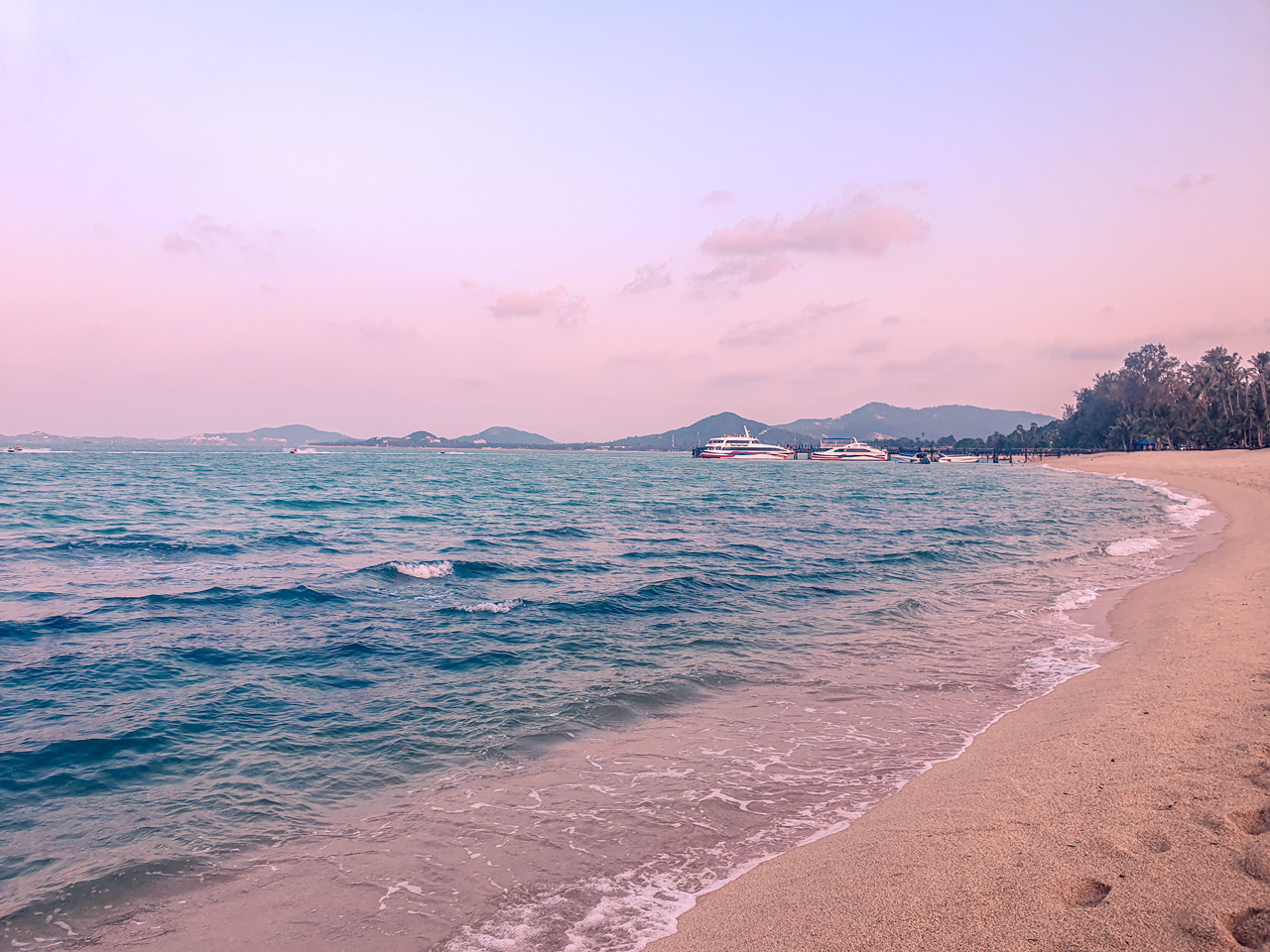
Samui is not merely an island — it is an island that has somehow managed to preserve itself, striking a delicate balance between civilisation, identity and nature. I arrived in the evening, and was struck, even then, by the sheer simplicity of the welcome: I stepped off the ferry straight into a small village that seemed never to have heard of tourists at all. Even on neighbouring Koh Phangan — considered the untouristed, wild island, the one people travel to in search of enlightenment — the port is ringed by the small town of Thong Sala. Further inland, Samui’s civilisation begins to show itself in thin veins: large petrol stations, cafés in both local and European style, even a sizeable Lotus supermarket and a single shopping mall. Exactly one — and, it seems, Samui will permit no more, as though to say: “One is quite enough for you. Everything you need is here. Now enjoy the island’s beauty, and forget about shopping.”
And indeed, looking about you, all you can think to do is open your eyes wider still, so as not to miss even the smallest drop of beauty, while a gasp of wonder escapes you quite of its own accord. I felt as though I were seeing Thailand anew, from an entirely different angle: beaches of white sand stretching for kilometres, scattered here and there with enormous boulders; the sea rolling shamelessly onto the shore — now in gentle little waves, now in swells unusually large for the Gulf of Thailand, one of which caught me on the beach and soaked me almost to the waist; impossibly tall, slender palms stretching their comical crowns of leaves towards the sky; viewpoints perched in places that demand real courage and stamina to reach; and, rising at the island’s centre, mountains that seem to hold on to something distinctly human.
Samui carries itself with a certain freedom, and treats its guests with the same easy liberty. It feels like the rightful master of this stretch of the Gulf of Thailand, and will let no one disturb its peace. And yet it loves everyone, and lets each of us delight in it all the same.
Samui feels like a living island — perhaps this is where the tradition of building little spirit houses, and feeding them biscuits, first began. Here, planning is pointless; far simpler to make a wish and surrender to the island’s will, since it will do exactly as it pleases regardless. It might choose to pour rain on you — or it might let you circle the entire island, watching the wet asphalt glisten at every kilometre, without a single drop ever touching you. And it seems to show each visitor something entirely its own. If there is something you are not meant to see, the island will go to considerable lengths to ensure you don’t: it will lead you astray, drown you in rain, block the road, or simply — quite literally — remove the sight from view (not literally, of course))). And show you something else instead. Of everything I had planned to visit on the island, I saw none of it — and yet I saw so much that was new. Beneath the tropical downpours, the island ran its waterfall dry, only to cast me straight out of the depths of the jungle, two kilometres from where I stood, so that I might admire Samui from a distance — and, quite literally, walk upon the water)))).
Samui is an island where miracles still live, and one to which you must, without question, return.


