Let me tell you about a place where the past brushes against the future, where earth meets sky, and where thoughts simply stop running and come to rest.
Places like this do exist on Earth, but reaching them takes real effort, and feeling their magic takes a certain readiness on your part. Wanting to experience the full depth of it isn’t enough on its own — something more is needed, something within you — otherwise it remains nothing but a pretty view.
Places like this are usually found far from human paths, well off the popular tourist routes. But not this time. Doi Inthanon is Thailand’s highest point, standing at around 2,500 metres above sea level. Plenty of Thais come here, and rather fewer foreign tourists, at least compared with Pattaya or Phuket. So I expected nothing from the mountain beyond some pretty views. Life, however, had other plans.
Let me tell you a little about the place itself first. Long, long ago, the mountain was known as Doi Luang, before being renamed, several centuries back, in honour of one of the rulers of the ancient kingdom of Lanna, which once occupied this territory. The king was buried at the foot of the mountain, and his remains lie there to this day.

In more recent times, another king — Thailand’s Rama IX — moved by a genuine love and care for nature, ordered a national park established around the mountain to protect its flora and fauna. Which is why, today, the area around the mountain holds little but forest, waterfalls, rivers, winding mountain roads, and a handful of small farming villages. There’s one exception, though: an observatory has been built here for astronomical research, housing one of the largest telescopes in Asia.
Had I simply arrived at the mountain by the usual route, I might never have felt what I ended up feeling. As it happened, the path that brought me there was anything but usual.
My trip to Chiang Mai came together on impulse, and in the rush of planning it, I put together far too ambitious a list of activities — so even with an extremely packed schedule, some of it had to go. I dropped a walk through the national park in favour of visiting the elephants instead. The road to the elephant farm wound deep into the mountains, into country with nothing of any obvious interest to tourists — just small Thai villages clinging to the hillsides. There turned out to be no elephants at all; the farm was either closed or simply abandoned. What I did find, instead, were a few tiny black piglets. The mountain was next on the itinerary, but rather than send us straight along the main road, Google decided to route us instead through a maze of mountain switchbacks.
Which, as it turned out, let me see the local villages properly, take in the strawberry plantations, and admire the extraordinary views opening up from the cliff edges. That same detour is also how I stumbled onto a market that was entirely, unmistakably local — it felt as though no foreigner had ever set foot there before. The local women eyed us with open curiosity, exchanging amused glances and laughing quietly among themselves. They didn’t speak a word of English, and I knew all of two words of Thai: ‘sawadika’ (hello) and ‘khob khun ka’ (thank you). Even so, between laughter and hand gestures, I somehow made myself understood, and came away with baked sweet potato, fresh strawberries, and rice crisps. That’s where I learned sweet potato can actually be purple. It was, genuinely, one of the finest meals of my entire life — everything impossibly fresh and delicious, the air clean, a stray cloud caught in the branches of the forest nearby.

Then came Siriphum Waterfall, plunging down somewhere impossibly high in the mountains. It appears suddenly from behind the trees and vanishes again just as fast. I remember the sheer shock of seeing it. But there was nowhere to stop — the road was one long mountain switchback, a rock face on one side, a sheer drop on the other. I simply pulled out my phone, hoping to catch something, anything, in the next brief gap between the trees. And then, right after the next bend, a genuinely spectacular viewpoint opened up over the waterfall. That was it — a gift, plain and simple. I had my camera, tripod and telephoto lens sitting right there in the car. The only thing missing, for absolute perfection, was my filters — left behind in Pattaya — but my sunglasses came to the rescue, the same trick I’d used back in Bali to shoot a waterfall on a long exposure, and I did exactly the same thing here.
Beyond the name Siriphum, I could find nothing else about this particular waterfall. So going purely by eye — and my sense of distance is genuinely terrible — I’d guess it drops around 100 metres, sitting at roughly 1,500 metres above sea level. By this point we were already high in the mountains, with wisps of cloud caught here and there in the low ground. I’d guess that, visiting at the end of December, in the dry season, the waterfall is on the modest side; in the rainy season, it must look genuinely powerful.
By the time I reached the point where the climb up Doi Inthanon actually begins, I felt emotionally empty… or perhaps entirely full. My sense of wonder had gone completely off the scale and simply burned out; my capacity for expectation had short-circuited entirely. I no longer expected anything, was no longer capable of being surprised by anything — and, somehow, I received everything anyway.
To reach the mountain, I was assigned a guide — a slight, silent young Thai man who announced straight away that he didn’t speak English, and spent the entire walk simply keeping an eye on me so I wouldn’t get lost. Getting lost, as it happened, would have taken some doing — it was a path worn smooth by thousands of feet, often laid with wooden boardwalks; quite what the guide was actually there for remained something of a mystery.
I walked a long while through the jungle, saw the waterfall, savoured the silence. There were mercifully few tourists about, and only once did a loud group of Portuguese — or perhaps Spanish — overtake me.

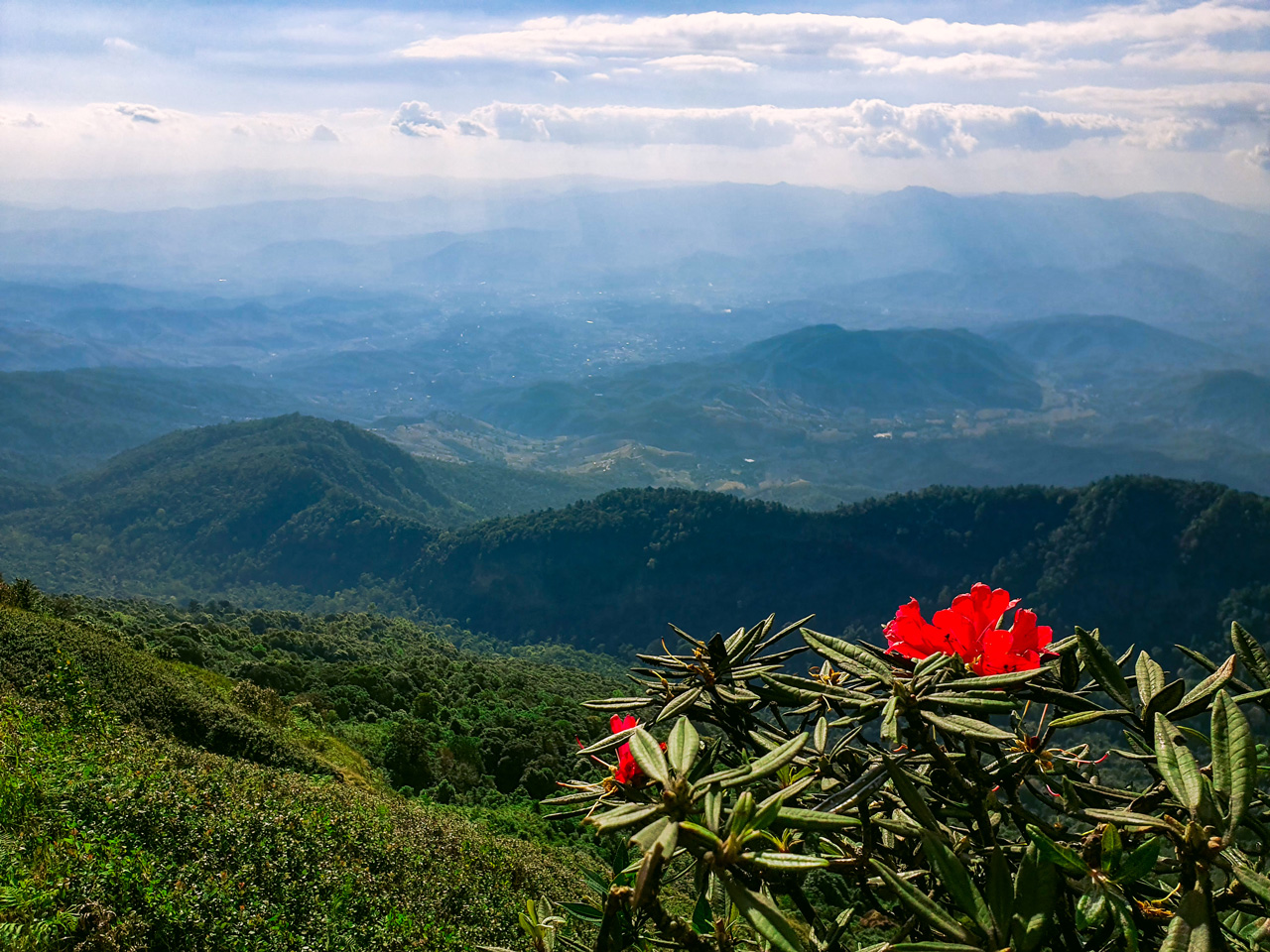
My senses had been quietly lulled by the cosy canopy of trees overhead, blocking out the sky, and then, stepping out into open ground, the view from the mountain hit me like an ocean wave — pulling me under completely, giving me no way back up to the surface. With every internal sensor already burnt out, the beauty simply flooded every cell in my body, leaving nothing else inside me at all. Time, in that moment, simply stopped. I sat down in a corner where no other tourists happened to be, and just watched. All I remember is the beauty pouring straight through me, as though I’d become some kind of channel for it.
I sat there for around 40 minutes. My Thai guide stood off to one side, chatting with colleagues, simply waiting. When I was finally ready, he led me down a different path along the slope — which, it turned out, was exactly what he’d been there for. And still the beauty kept pouring in.

By the time I stepped off the path, it felt as though my soul had just been thoroughly steamed in a sauna, beaten clean with fragrant birch branches. Every trace of the everyday had been washed away. Nothing mattered, for a little while — absolutely nothing held any meaning at all.


