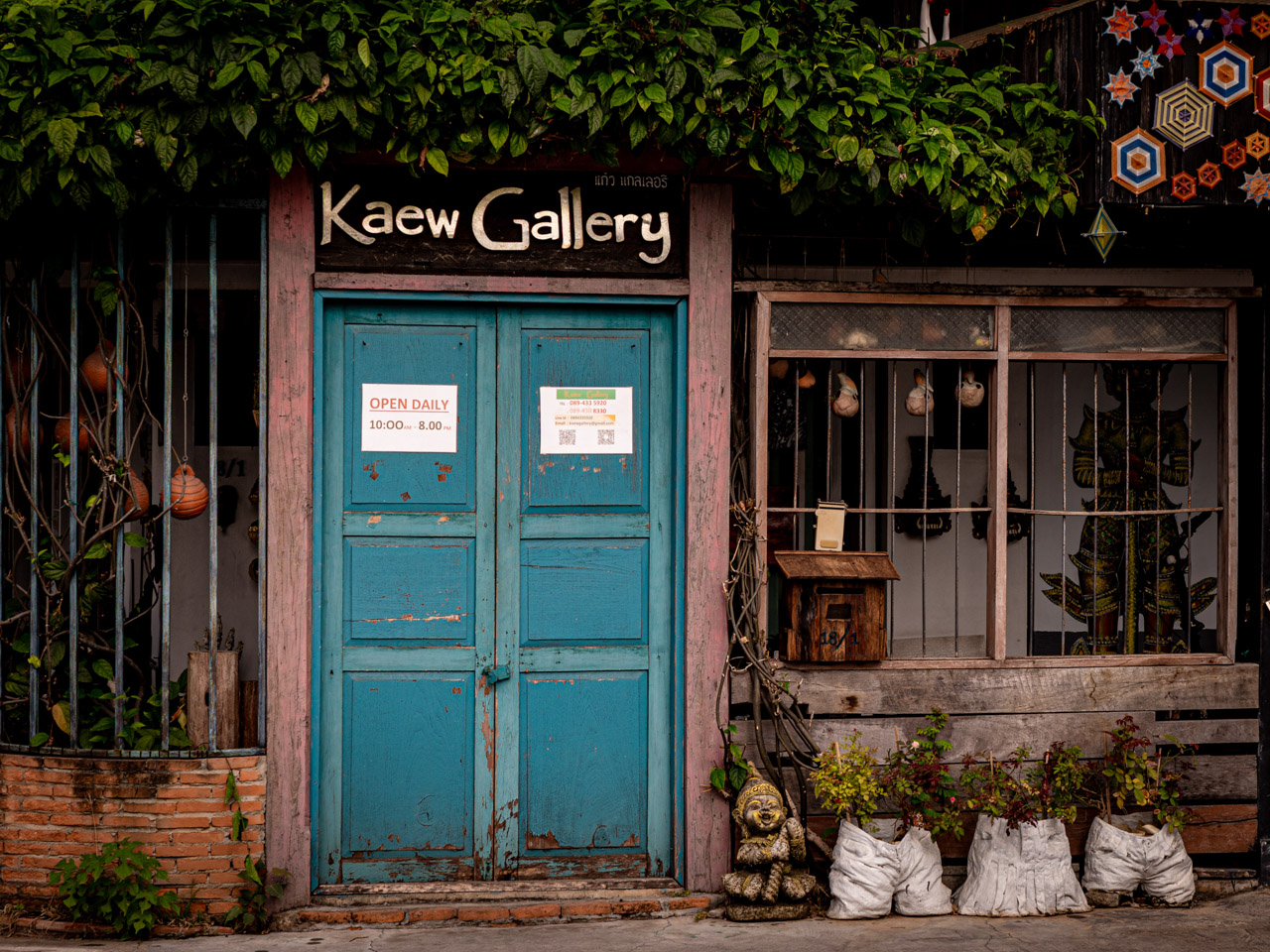
My first trip to Chiang Mai came about entirely on impulse. I was having dinner at one of the Night Markets in Pattaya and fell into conversation with a woman sitting nearby. She’d flown back from Chiang Mai just the day before, and her impressions were still fresh and vivid. On the way home, turning her story over in my mind, I decided I needed to go to Chiang Mai — urgently.
Chiang Mai is an ancient city in northern Thailand, the second-largest after Bangkok. It sits ringed by mountains, and by every account and photograph I’d seen, the setting is extraordinarily beautiful.
As it turns out, you can’t simply sit down and write “here’s Chiang Mai, and this is what it’s like” — the city is far too complex to sum up in a couple of sentences. So let me start with a little history, and with my own expectations going in.

I’d already heard about Chiang Mai from friends living in Thailand, and nothing but glowing reviews. Even so, I’d travelled around enough Thai cities by then to have built up a working theory of my own: “no tourists means Thai style.” There’s nothing wrong with Thai style, as such — it’s simply unfamiliar territory for most Europeans. What I knew about Chiang Mai amounted to roughly this: no sea, therefore no tourists; plenty of temples, drawing pilgrims rather than holidaymakers; altogether a different crowd of visitors. And so I braced myself for a heavy dose of Thai style… well, perhaps not heavy — just Thai style, plain and simple.
What exactly is “Thai style”? Restaurants serving local food where “no spicy” still comes out closer to rocket fuel; English that’s either painfully broken or entirely absent; and thoroughly modest hotels — a cramped room with nothing but a bed for furniture, ageing tiles in the shower, and, naturally, cockroaches of truly heroic proportions, which honestly deserve a story all of their own.
But first, a little history.
A Brief History of Chiang Mai
The city was founded in 1292 by a prince, following his victory in battle over a small kingdom that once occupied part of what is now Myanmar. The region back then was scattered with countless small principalities and kingdoms, forever at war with one another. Chiang Mai itself, in fact, wasn’t really “Thailand” at all in those days — or rather, at that point, there was no Thailand, only Siam. It was the capital of a modest kingdom called Lanna, and its name, Chiang Mai — “new fortress” — reflected exactly that role.
The old fortress still survives today. On any map, you’ll find it right at the heart of the city: a near-perfect square, each side roughly 1.4 kilometres long, formed by the old city wall. Built to defend against invasion from Burma, sections of it still stand intact. But Burma wasn’t Chiang Mai’s only adversary — it fought Siam too, and fiercely enough that the conflict lives on in local legend to this day.

Over nearly two thousand years of history, the city gradually grew into what it is now: the second-largest in Thailand. Modern Chiang Mai resembles no other Thai city — thoroughly distinctive, and yet unmistakably Thai at the same time. It’s a patchwork of different districts: modest, typically Thai neighbourhoods; wealthier ones; the old town within the fortress walls; and even an arts district, Nimman. Wandering through Chiang Mai, I found myself struck by the blend of European and Asian styles, and by just how tidy and quietly elegant it all felt — a quality not exactly common across much of Asia.
You might assume the city is full of Europeans, but that’s not quite the case. In places genuinely saturated with Europeans, locals grow used to us and pay us no particular attention. In Chiang Mai, it’s rather the reverse: locals watch with real curiosity, and in some neighbourhoods, with open surprise. There are foreigners here, certainly, though of a distinctly different sort from those you’d find in Pattaya or Phuket. Most who settle here have already spent time elsewhere in Thailand and grown weary of the crowds and the tourist bustle. As a result, the foreigners you meet in Chiang Mai tend to be settled, calm, with their lives already arranged, and with a clear sense of what they want from the city. Some have even built businesses here — and I wouldn’t be at all surprised if that were true of a great many. But foreigners aren’t the only thing shaping the city’s character. They’ve certainly contributed to its development, but I doubt they’re the main force behind Chiang Mai’s unusual, modern trajectory.

Chiang Mai has an unusually high concentration of universities, and, correspondingly, a large student population — proportionally, perhaps even larger than Bangkok’s. This brings two things with it. First, a genuine creative energy: this is a city willing to actually follow through on ideas. Second, university education in Thailand is expensive by local standards, meaning most students here come from comparatively well-off families — which, I’d argue, gives Chiang Mai a certain economic stability of its own. Combine that creative energy with real economic footing, and the near-total absence of conventional tourism, and you get some genuinely interesting conditions for growth.
On my first day in Chiang Mai, I wanted nothing more than to stay, or at least to come back and live there. But once the initial excitement settled, a clearer realisation set in: it isn’t Chiang Mai itself I should return to, but everything that surrounds it — above all, the mountains and the landscape. That landscape feels distinctly different from both the eastern and western stretches of Thailand’s coastal “horseshoe,” likely because this region sits some 800 kilometres north of Pattaya, and 1,500 kilometres north of Phuket.
Time itself seems to move differently in Chiang Mai — slower, longer, more languid. Five days in a big city might pass in what feels like a few hours; here, those same five days stretch out to feel like several weeks. It’s a curious, almost disorienting sensation, and one genuinely worth experiencing for yourself. Plenty of places on this earth share that same quality, though it never quite feels the same twice.
Chiang Mai itself is a wonderful city simply to walk through, whether in the old town or the newer districts. The weather makes it possible to wander at any hour of the day, and moving through the city unhurried is, I think, the best way to truly get a feel for it.


