Chiang Mai Zoo isn’t quite a zoo, and isn’t quite a nature reserve either — it sits somewhere between the two, built around a large natural landscape, a scientific and educational approach, and the chance to see something close to the real habitats of various animals, birds, and even marine life, all in miniature.
I went to Chiang Mai Zoo specifically for the pandas — I’d never seen one in the flesh, and I was genuinely eager to make their acquaintance. That, it turned out, will have to wait for another visit.


History of Chiang Mai Zoo
The zoo began as the personal passion of an American named Harold Mason Young, whose parents had come to Thailand as missionaries; Harold himself, during the Korean War, trained soldiers and police officers in jungle survival skills. He lived in Chiang Mai, at the foot of Doi Suthep, and his love of the forest didn’t go to waste. He would regularly come across injured animals in the jungle, bring them home, and nurse them back to health. As their numbers grew, he was eventually given a plot of land at the foot of Doi Suthep to set up a private zoo. This all took place in the 1950s.
The zoo opened its doors to the public in 1957, and Harold continued to run it right up until his death in 1975.
Two years later, on 16 June 1977, Chiang Mai Zoo was handed over to the organisation overseeing all of Thailand’s state-run zoos — the Zoological Park Organization of Thailand. From that point on, its status effectively shifted from private to public.

Where is Chiang Mai Zoo located
The zoo still occupies the same site today as it did back in the mid-twentieth century: on the outskirts of Chiang Mai, at the foot of Doi Suthep, on land that retains its natural forest landscape. Thanks to this, the grounds include forest, slopes, bodies of water, even waterfalls, and, naturally, plenty of green open space and areas of untouched natural terrain.
Of course, Chiang Mai Zoo can’t be equated with a genuine nature reserve, nor can it claim its animals live entirely in the wild. Even where certain species — herbivores, for instance — are given fairly generous enclosures, these remain limited in size, nowhere close to the scale of a true natural habitat. Even so, it’s enough to give the animals a real sense of freedom of movement, and to see them roaming rather than confined to cages or the cramped enclosures common at many city zoos.

Animals at Chiang Mai Zoo
Chiang Mai Zoo houses an impressively broad range of species. Some sources put the figure at 400 or more. In practice, though, you’re unlikely to see every single resident, however many there might be. The simplest reason is that animals may be resting, sleeping, sheltering from the heat in the shade, or simply less active at any given time. Animals are also occasionally moved while enclosures are repaired or cleaned — or, on occasion, because something has happened to one of the zoo’s residents. Yes, they’re living creatures, and things do happen to them from time to time.
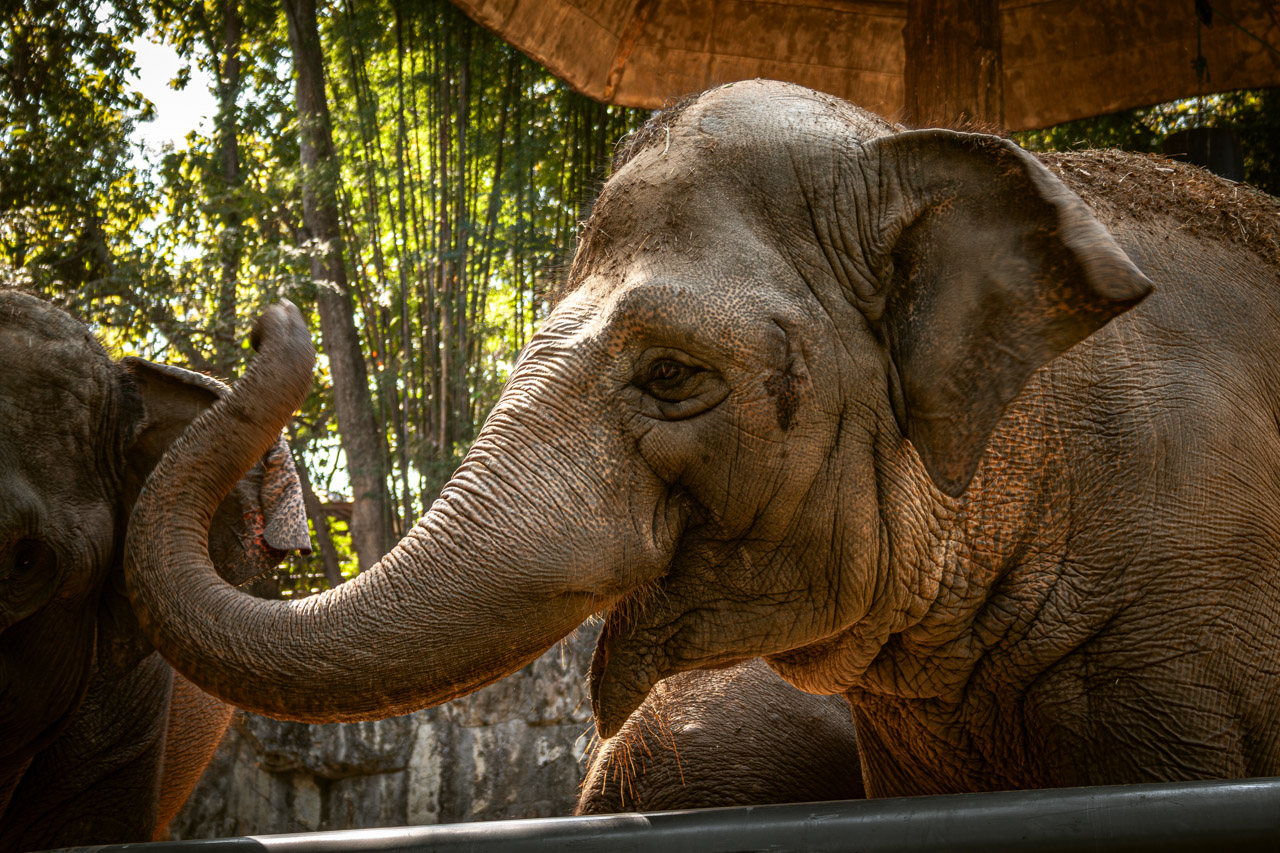
Whatever the exact number, Chiang Mai Zoo is home to a genuinely vast array of animals. Among the mammals: Asian elephants, of course, along with a range of herbivores — gaur, giraffes, goats, deer and more — a good number of primates, and predators including lions, panthers, tigers and others. There are also kangaroos, koalas, hippopotamuses, and plenty more besides. Among the wide variety of birds are ostriches and penguins, and the zoo is also home to reptiles, amphibians, fish and other aquatic species.

Are there pandas at Chiang Mai Zoo
Chiang Mai Zoo is best known for its pandas, and they’re easily the most sought-after residents among visitors. I was, in fact, one of those visitors who’d come specifically to see them. With great anticipation, ready for my wish to finally come true, I pushed open the door of the panda pavilion… only to be greeted by one of the zoo’s staff members, who spoke almost no English but managed to convey, quite clearly, “No Panda.” I was disappointed, naturally, but the rest of the zoo’s animals soon helped me forget the letdown.
So where had the pandas gone?
In 2003, as part of a cooperation programme, two giant pandas arrived at Chiang Mai Zoo from China: a three-year-old male, Chuang Chuang, and a two-year-old female, Lin Hui. In 2009, the pair had a daughter, Lin Ping, a major event for the zoo that drew attention from across the whole of Thailand.
Chuang Chuang and Lin Hui remained at the zoo for the rest of their lives. Chuang Chuang lived to 19 and passed away in 2019; his partner, Lin Hui, lived slightly longer, to 22, passing away in 2023.
Lin Ping stayed with her parents for only four years before being sent back to China. The pandas had been loaned to Thailand under an agreement that kept them, and any offspring, the legal property of China throughout.
Lin Ping went on to take part in a breeding programme and proved a remarkably successful mother, giving birth to three sets of twins and one additional cub. Pandas remain rare worldwide: around 2,000 live in the wild, and roughly 600 in captivity. Though pandas have since been reclassified from “endangered” to “vulnerable,” they still need active protection, and growing the population depends on breeding programmes exactly like the one Lin Ping took part in.
Which is why, visiting right at the end of 2023, I never got to see any pandas at Chiang Mai Zoo — they’re simply no longer there. Here’s hoping pandas find their way back to Chiang Mai Zoo again one day.

Chiang Mai Zoo Aquarium
Another fascinating part of the zoo I managed to miss, entirely through my own disorganisation. The aquarium requires a separate ticket, and you need to actually ask for it at the counter. Thai staff tend to be wonderfully unpushy and won’t try to upsell you anything beyond what you’ve specifically asked for — which means it’s on you to do your homework in advance and know exactly what you need to buy.
The Chiang Mai Zoo Aquarium centres on a 66-metre underwater tunnel, home to both marine and freshwater species. There are also dedicated displays on coral reefs, sea anemones, tropical fish, jellyfish, rays, and various marine predators, sharks included.
Keep an eye on more than just the tickets, though — the aquarium’s opening hours can differ from the zoo’s.

Chiang Mai Zoo conservation and education programs
Chiang Mai Zoo isn’t purely a tourist attraction — arguably, that’s not even its primary role. One of its most active areas of work is scientific research and education, and this is baked directly into the zoo’s official vision, stated as: “To be the centre of education, conservation, research and wild animal tourism of Chiang Mai Province and northern Thailand.” Among the zoo’s stated goals is raising the standards of Thailand’s zoos and wildlife research centres to meet international benchmarks.
Accordingly, the zoo places real emphasis on educating and engaging children and young people. Walking through the grounds, I kept coming across groups of children — schoolchildren, presumably — brought in to learn about the animals. I couldn’t follow what the teachers were telling them, since it was all in Thai, but I was genuinely pleased simply to see this kind of programme in action, and by how engaged the children clearly were.

In 2025, Chiang Mai Zoo also signed a Memorandum of Understanding with the College of Arts, Media and Technology (CAMT) at Chiang Mai University, covering joint research, development, information-sharing, internships, the creation of educational content, and the wider dissemination of wildlife knowledge, among other areas of cooperation.
The zoo also actively maintains partnerships with other organisations across Thailand, the ASEAN region, and internationally.

Interesting facts about Chiang Mai Zoo

There are two waterfalls within the zoo grounds.
The zoo also has its own artificial winter — Snow Buddy Winter Land, a dedicated pavilion kept permanently at –10°C, complete with real snow.
Another attraction is Dino Island, a virtual entertainment world built around dinosaurs.
A golf cart service operates throughout the grounds, so you can either walk the zoo on foot or ride around it.
The zoo also runs a Green Zoo Policy, one strand of which is the Manure Selling Project — treating animal waste as part of a broader ecological and economic system.
The zoo grows its own plants to feed its animals.
More than 3,000,000 people visit the zoo each year.
Tips for visiting Chiang Mai Zoo
Come in the morning
The zoo grounds are large, and even by golf cart, getting round the whole site takes a fair amount of time. By midday, temperatures climb, and the animals tend to retreat into the shade to escape the heat.
Think carefully about whether to walk
I walked the entire zoo on foot myself. Yes, I stopped often to photograph the animals, but even I — someone who happily clocks up 30,000 to 40,000 steps a day without much thought — ended up exhausted. Partly the heat, even visiting at the end of December; partly the sheer number of climbs and descents; and partly the fact that benches to rest on are few and far between. If you’re not up for walking, and walking, and then walking some more, take advantage of the transport on offer — especially worth considering if you’re visiting with children.

Plan your route in advance
Stop at the map, take a photo of it, and think through your route before setting off — whether you’re walking or using the transport. On foot, there will come a point where you simply won’t want to backtrack to an area you missed. By cart, you might find certain roads closed, or need to double back or take a detour. The zoo’s grounds are vast, with a fairly complex network of roads.

Treat the aquarium as a separate visit
The Chiang Mai Zoo Aquarium is best visited in the afternoon — it’s pleasantly cool inside, and a good place to recover after walking the grounds. And don’t forget: it requires its own separate ticket.
Check the zoo’s status before you go
The zoo is a living, changing place, and some exhibits close while others open. It’s worth checking the website in advance for opening hours and which exhibits are currently open.

Don’t expect to see every animal
Enjoy the walk, the visit, and whichever animals you do get to see — don’t chase the impossible goal of seeing absolutely everything. Animals hide, you’ll get tired, you’ll miss a turning somewhere. And the koala, for what it’s worth, sleeps around 20 hours a day — count yourself lucky if you even spot that grey little bundle tucked away in the branches.
Don’t plan anything else for the day
Nothing major, at least. The zoo can easily take longer than you’d planned, on top of the sheer tiredness that comes with a day of activity and new sights.
Footwear, water, a hat
And the most universal piece of advice for Thailand generally: bring water, cover your head and any exposed skin, and wear comfortable shoes.


